
love's bad infinity
tristan und isolde - in theory and at the met

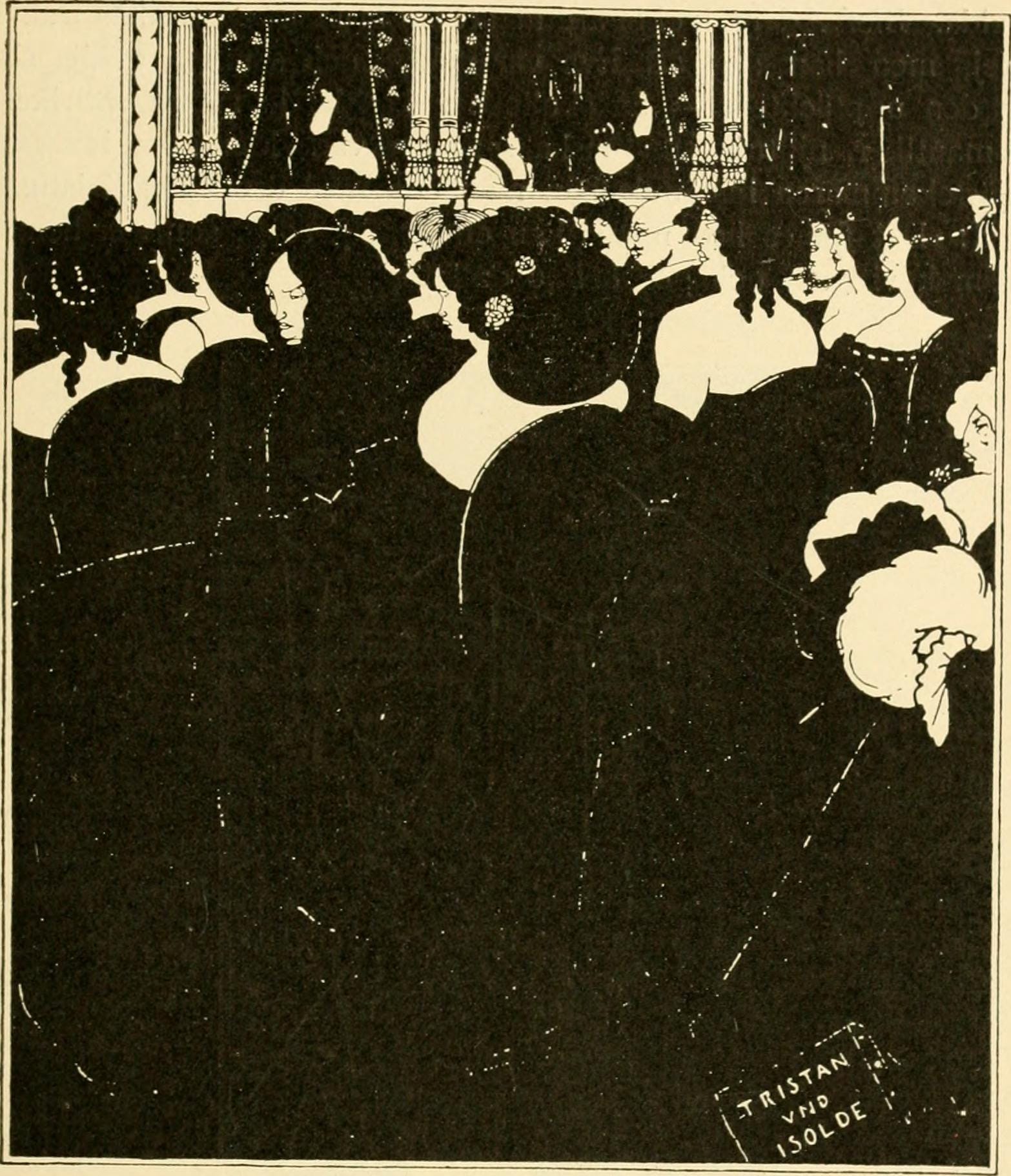
It is a bit of a misconception to say that Tristan und Isolde is about love. On its face, it appears to be a love story, but to call it that is kind of like saying a child who takes piano lessons is classically trained: a little white lie. In truth, Tristan is about power; specifically, it is an elaborate fantasy of powerlessness. Through this powerlessness, all is dissolved — right and wrong, agency and fate; even the distinction between a man or a woman is rendered meaningless; indeed, one need not even be dead or alive.
That sex can do this for us (and yes, it is more accurate to say that Tristan concerns sex more than it concerns love) is a common fantasy throughout history, though it has become increasingly so as the gender divisions in everyday life become more openly fractious and violent than they have been in quite some time. One need only to take a look at contemporary writing to see that this is true, whether in the form of constant posting about yearning as a practice (though I consider this posting mostly performative because, like everything else on the internet, it is a little bit ironized) or the prose stylings of today’s romance fiction in which protagonists are rendered through the orgasm shattered, helpless, quivering and desperate; in the romance plot, previously stoic partners are subdued, awakened and made morally good or kind through pleasure. The term quiet violence, one I think Wagner would certainly approve of, has become a staple of ChatGPT prose.
In short, there has never been a better time to go see Tristan. There has also never been a better time to see Tristan at the Met. There remain two performances left to see, and about the production itself I’ll get to in more detail at the end of this post. However, suffice it to say, if it is in any way possible, you should go see it (or, if you’re not in New York, the simulcast at your local movie theater.) The hype — which far exceeds that of any other production the Met has put on in years — is real.
While most of my work about Wagner concerns the Ring, Tristan was my first foray into being a Wagnerite, simply because it’s the most musically important of his operas. Anyone who has read the Wikipedia page for opera can tell you that Tristan set new boundaries in terms of both tonal chromaticism (especially in the eponymous opening chord and the cor anglais solo in the third act) and opera as a philosophically self-contained structure. But to understand Tristan beyond that, one must also understand the questions Wagner is really asking in it: what is and isn’t love, is and isn’t power, is and isn’t self and other, is and isn’t fate. This is a big ask, but it’s worth taking a crack at it. If you’re less interested in such pontificating, you can simply skip to the back half of this post where I get into the review itself. At any rate:
why tristan? why now?
Not to be the guy who cites Hegel, but: Hegel, in the Phenomenology of Spirit makes a distinction between two types of infinities: the good infinity (found, for example, in the processes of the body, life and nature) which is perfectly cyclical, and the bad infinity which continues ceaselessly into the void and takes everything else with it. The traditional operatic form, regimented in its neat cadences, its arias and recitatives, approaches something like the good infinity. Wagner’s suffocating yet systemic worlds, his unsatisfying resolutions, his endless melodies, and, yes, per the jokes, the sheer lengthiness of his work, land him squarely in the bad infinity zone. And love, in Wagner, is without a doubt the baddest of all bad infinities.
This is not only because it never ends well (and it truly, honest to god never ends well) but because Wagner’s dialectical solutions to the problem of love, of which Tristan and Die Walküre are the most advanced, are iterative only in each successive work. In the works themselves, their own totality, musically and otherwise, swallows up each and every character, their wills, their desires, their fates.
As the years go by, the answers to these problems of freedom and fate only ever seem to become more elaborate and more bleak.1 By the 1850s, death, in Wagner’s work, was the order of the day. Tristan and Isolde famously die for love (though their deaths are always somewhat ambiguous), as do Siegfried and Brünnhilde before them (in order of composition), and Siegmund and Sieglinde, Wagner’s most politically developed lovers, in their wake.
That being said, it is wrong to call these bad loves reactionary in character. During Wagner’s work on Tristan and on the Ring, he was particularly interested in relations of power between men and women. (In fact, right before he died, Wagner was working on an essay on the woman question which, sadly, he never finished.) The gendered nature of the power question is, more than the more famous element of fatalism itself, essential to understanding what happens in Tristan and what Tristan means.
Wagner has always been interested in contracts — fundamental structural rules whose ruptures usually have terrible consequences. In Tannhäuser, the titular character violates his contract of love-bondage with the goddess Venus in order to form a new, more pious one with God in the more humble pursuit of his human-love, Elisabet. In Lohengrin, Elsa, wrongly accused of killing her brother, is protected and loved by Lohengrin, the swan knight, under the condition that she never once ask his real name or where he’s from. (Of course, on the precipice of making love, she does.)
But in these earlier works, Wagner’s women are frail, pious, and often helpless. They fall into archetypal operatic roles — the damsel in distress, the radiant virgin, or, in the case of his villains, the lusty witch.2 By the time he starts working on the Ring, Wagner all but abandons these traditional gender dynamics in lieu of one in which powerful women approach, in ways both political and affective, something like real parity with men. If anything, Wagner’s later women (with the annoying exception of the sorceress Kundry in Parsifal) are both stronger and more complex than their male counterparts. As we will soon see, this is perhaps most explicitly true of Isolde.
The works’ structural contracts, by extension, change to reflect this reality. They, too, become more complex. Death soon becomes necessary to resolve the contradictions of not only love but the world in which that love takes place. Before Wagner wrote Tristan he wrote Siegfried which ends with Siegfried — whose entire life has been basically orchestrated by Brünnhilde so that he comes in contact with the infamous ring, slays the dragon, and comes to meet her on the great fell — singing with her in a loud chorus of two about death and love, love and death.
In Götterdämmerung, the curse of the ring comes to fruition and the whole world literally burns to the ground, but not before the questions of power and agency are elaborated upon in the form of what can best be seen as a double rape — Siegfried is drugged by the villain Hagen and, no longer in control of himself, is forced to abduct Brünnhilde so that the coward Gunther can take her for wife. This is so terrible that both of them end up dead for it — Siegfried is killed, Brünnhilde takes her own life. The contradictions of love and power are resolved, but at what cost?
Tristan is both an iteration of and improvement on these conditions. (It is also a stepping stone on the way to Die Walküre in which Wagner’s hero, Siegmund, and his heroine, Sieglinde, are in every respect true equals with one another, albeit through the somehow even more fraught construct of fraternal incest.3) On its face, the structural problem of Tristan — the inescapable effects of a love potion on both parties — seems, at first glance, to be almost a simplification of what’s come before.4 But what differentiates Tristan from the situations in the Ring (and, actually, from all the other operas) is that Tristan starts out on the opposite dialectical foot. It begins outright with a righteous woman coming face to face with an unrighteous man, a man who has irredeemably wounded her. In other words, it begins, most crucially, with hate, a hate that must then resolve into love.5
The basic story of Tristan und Isolde is that, prior to the events of the opera, the warrior Tristan first comes by boat to lay waste to Ireland, where Isolde reigns as queen. He kills her fiance, Morholt, but is wounded in the process. Isolde, more out of erotic self-interest than pure charity, heals Tristan’s wounds only for him to return to Ireland and take her as captive with the intent of marrying her off to his much older adoptive uncle King Marke. This is, quite frankly, a totally evil thing for him to do. It is also, one could say, a violation of a prior, albeit unspoken contract.
Out of revenge for being subjected to the slave bond of unwanted marriage (the specter of rape, no matter how kindly the poor cuckold Marke may be, looms heavy in all of Wagner’s later work) Isolde intends to kill both Tristan and herself by way of a death potion given under the guise of resolving their differences — a toast to friendship. It is a common mistake to see this as an act of devotion towards Tristan, something Isolde does because she is in love with him. Instead, it has everything to do with not wanting to belong to anyone but herself. If she kills only Tristan, she remains in the same bad situation. Death is, essentially, the only way out with dignity.
At the last second, Isolde’s maid Brangäne swaps this death potion for a love potion, though, for all intents and purposes the outcome is the same — it just takes a little longer to get there than a swallow. At any rate, the two become fatally entwined and later, of course, get caught in the act. Tristan is wounded and banished to an island with his right hand man Kurwenal where Isolde (or her ghost — it’s always ambiguous) comes to his aid too late. Then there’s a big dramatic pseudo-aria called the Liebestod and it’s the best music of all time. The curtain falls.
Isolde is Wagner’s mightiest heroine. She eclipses even Brünnhilde in that she is never virginal and has a true hatred for weakness. That Isolde has been rendered weak is to her an unspeakable crime. Rather than giving herself to a man in the traditional sense, it is more accurate to say that she takes that man from himself. When Isolde speaks to Tristan in Act I, she speaks to him in the language of a man6 — a language of revenge, contracts, negotiation, hatred. Tristan, who knows he has wronged her, proffers his sword to her and dares her to kill him; he also knows he has met his maker. However, they find themselves in a kind of stalemate. Isolde, being a queen, is his political superior; Tristan, being a man, confers physical power over Isolde. Yet neither of them can act upon what they want because they are now in a Situation. A new and final contract must be forged between them.
The fantasy of Tristan, as I stated at the beginning, is one not of love, but of powerlessness. This is because, within the construct of the opera, only in powerlessness can one find true equivalency between man and woman, or, more accurately, a rejection of subjugation altogether in exchange for being totally subdued. In the endless, anorgasmic swirl of music for which the second act is so famous, there is ceaseless talk of oneness, of surrender, of dying, of becoming or dissolving into the other. Indeed, the potion creates a unique condition by which the boundary between self and other must be eroded completely, both corporeally and metaphysically. So, too, must the boundary (Wagner’s favorite) between agency and fate.
This is not done, as in the case of Die Walküre, through self-recognition in the other — the bond of solidarity — but instead through total and abject self-negation. Tristan is Isolde and Isolde is Tristan, but in being so, they are also nothing at all. This is not only a highly erotic situation but a dialectically paradoxical one. To recognize the self-consciousness of the other is to recognize one’s own self-consciousness, to deny one’s own self is to deny the other, too. No wonder the whole thing can only end up in death, and beyond death, a sexual fantasy of dying. By the time the pair meet up in the forest, they are already ghosts wandering among the living. The rest — the dying itself — is a mere formality.
Wagner’s infamous non-cadential music is not just analogous to the gradual suffusion of sexual pleasure, it is also, in a very real sense, the fragile perpetuation of life. When it ends, all expires, but we, gloriously, expire with it. There is no way out but through, no love without hate, no power without weakness. That, essentially, is the gist of Tristan. It is an opera about a woman and her reckoning with her own fate disguised as an opera about love. In many ways, there is no Tristan. There is only Isolde, in Tristan, in the world, forever. They won’t tell you this in the liner notes, but it’s the truth.
*
THE REVIEW
The most important thing about this whole ordeal is that, musically speaking, it is fucking awesome. People always ask me “how” they should listen to Tristan. The best way to listen to Tristan is with someone you are balefully if not despotically in unrequited love with. The second best way to listen to Tristan is, in true Wagnerian spirit, with another man’s wife. The third best way to listen to Tristan is simply as music. This is because the singing is what’s important; after the first act, the libretto ceases to make much sense anyway. This is especially true about the love duet in the second act and Tristan’s unceasing dying in the third. All the plot is in the first act, the rest is about being carried away by sound.
When I saw Tristan at the Met, I knew what I was getting into. Five hours of yearnmaxxing bifurcated by two overlong intermissions. I saw it with a stranger, a man I had never met before, who asked over DM whether I wanted his second ticket. We had a very generous meal together and a cigarette after.7 This, too, is as close to the ideal Tristan-seeing situation as humanly possible. (Seeing Tristan with a friendly stranger from the internet is hugely preferable to seeing Tristan with your spouse because then you have to have the whole “would you die for me” conversation afterwards.)
At any rate, what they (the reviewers) say about the singing in this production of Tristan is true. You have to go, you have to see it. As much as Tristan is about powerlessness, it is also about raw power. In fact, the way people talk about a soprano is also not unlike the way we talk about Tristan — in terms of the scale of her power and the emotional direction of her will. Lise Davidsen is, of course, the most talented dramatic soprano in the world, especially when it comes to Wagner. She is the world’s best Sieglinde, a role she prefers over others, and a role she’s sung several times. (She has yet to sing Brünnhilde, but she will next year.) If one can be the world’s best Sieglinde, well, that leaves a lot of possibilities for everything else.
Describing a singer’s voice in general terms is one of the most futile exercises in writing. I have to do it every once in a while for reviews and find myself coming back to the same words: lilting, powerful, massive, limpid, rich, smooth, clarion, deep, versatile, what have you. The fact of the matter is, in this case, this woman will make you afraid of her. By the end, she will make you cry. The Liebestod in Tristan comes as a relief to the listener, as the final end, the drying up of the libidinal well through unadulterated sadness. To have it sung so completely is rare, to have the opportunity to listen to something so resoundingly perfect in the flesh is even rarer. In this case, it felt historic. It felt like hearing it for the first time, way back when I was fifteen, Hildegard Behrens on the turntable serenading poor, dead Peter Hofmann (an eternal crush of mine.) Toes curled, mouth ajar in astonishment. Much like there are no words that can accurately describe the way a storm charges the air around you, or the feeling of watching a lover from afar, there are no words that can accurately describe this voice.
Then there’s Michael Spyres, of whom I am also very fond. Spyres is best known as a bel canto singer (i.e. a guy who sings, like, Rossini) however his forays into Wagner have all been extremely successful. He sung Siegmund at Bayreuth last year, a performance I really enjoyed for the same reason I enjoyed hearing him as Tristan: he has the requisite power to commit to Wagner but he also has the astounding neatness and balance of a stereo recording. This is a very rare quality in a singer, to be so even, to have the full range in working order, to make this stuff look easy, and, beyond that, for the voice to be lofty and beautiful at the same time. Spyres makes a great Tristan because he has the agility, expression and endurance for it. He also makes a great Tristan because he is a little bit more subdued than his counterpart.
As for the rest of the production, my opinions are mixed. The supporting cast was mostly excellent — especially Tomasz Konieczny as Kurwenal, who is legitimately one of my favorite bass-baritones working right now. (Honestly, his voice is so powerful he basically deafens Spyres in their dialogues in Act III.) I was a little less sold on Ryan Speedo Green as Marke, but only because of the contrast with Konieczny. If anything, I felt they should have been switched for balance.
The conducting, however, was another story. I am of the very unfriendly opinion that Yannick Nézet-Séguin is a mediocre Wagner conductor who struggles with balance and pacing, both of which are important when your opera is five hours long. Across the board, he favors the tritest parts of the score over its more intelligent textures, which is a mistake. He is lucky Lise Davidsen is a weapon. There were many moments where I was actively resentful someone else wasn’t at the podium. Sorry to be mean, but it has to be said. This doesn’t ruin the performance by any means, but the seasoned Wagnerite will definitely be rolling their eyes.
Yuval Sharon’s constantly moving monoset, which looks at its best like the aperture of a camera and at its worse is suspiciously vaginal, while visually striking, is another sore spot. It is, unfortunately, an acoustical fatal error. The worst possible thing you can do for the listeners in the balconies is cut off the singer at the head by putting him in a giant cone, which essentially swallowed a lot of Spyres' midrange for those not seated in the orchestra section. Sometimes this set was very effective, such as in Act III where it served as a metaphor for going into the great beyond. However, the surrounding projections, some of which were almost ridiculously banal — moths to a flame, anyone? — were not only distracting, they gave me the feeling that the Met must think I’m a fucking idiot. The same could be said of Clint Ramos’ costume design, which came off as a mixture of the childlike medieval garb from Shrek (especially Davidsen’s green dress) and, in the cases of Kurwenal and Melot, the stillsuits from Dune. One must ask: what are we doing here?
All that being said, you have to go see Tristan at the Met because the opera is not really about what people are wearing or about whether they are trapped in a giant cone. It is about the singing, and Davidsen and Spyres are the two of the greatest singers working in the world right now. To have them together in the United States is a rare blessing, one we’ll probably be seeing less of as the political situation unfolds. (Most singers, even the American ones like Spyres have visas or citizenship in Europe.)
But beyond that, Tristan is timeless. The desire to blot out the sun of someone who doesn’t love you is timeless, the desire, as a woman, to be in charge of one’s own fate is timeless, the refusal of subjugation, even in its most problematic form, is, right now, especially timeless, as is the escapist dream of a world in which nothing matters more than somebody else, in which love — even if it’s not really love — is all there is. Tristan is a suicidal opera. We live in a suicidal moment. Go see it. It’s, as they say, to die for.
And then there’s Parsifal in which the solution to the love problem is a bunch of guys hanging out in the beneficent light of god’s mercy. Or whatever.
His earlier men are also helpless, albeit in a much hotter way. To use our previous examples, Tannhäuser licks the fucking floor Venus walks on; Lohengrin is what we would now call a soft boy: effete, devoted, sweetly naive, there for the taking. That’s gender, baby!!!
This is an insane concept with which I am problematically obsessed.
Thematically Tristan is basically a simplification of the mechanisms of the entire Ring. The undercurrent of rape, the altering of the mind, the curse, the loving death, the struggle of agency and the succumbing to an inescapable fate, the complex roles of men and women, women powerful, men subdued, it’s all in there.
Real Tristan heads know that this hate is actually the sexiest thing about the opera. Without it, there would be nothing, nothing!!!!
Wagner would immediately repeat this structure in his characterization of Brünnhilde in Die Walküre, who negotiates both Siegmund’s fate with Siegmund and her own fate with her father, Wotan.
I also ran into my friend the historic preservationist Theodore Grunewald at intermission. The whole evening was a testament to, as they say, the power of music to bring people together. Thank you, John, for the tickets!
goddamn but you write absolutely beautifully about opera. i have yet to really get into wagner because i end up being tired by the sheer length, i dont mean that insultingly. i should try again - what is your favorite non-Met downloadable/streamable version of tristan and isolde?
oh -have you ever listened to bajazet btw, and have thoughts?
Phenomenal piece and review. I was blown away last Saturday and going back (with better seats thankfully) on the 4th. Wagnerism is back - for better or worse. The resonance of this particular production is an exclamation point. Or maybe it’s just Lise Davidsen