
whatever it takes
on monomania

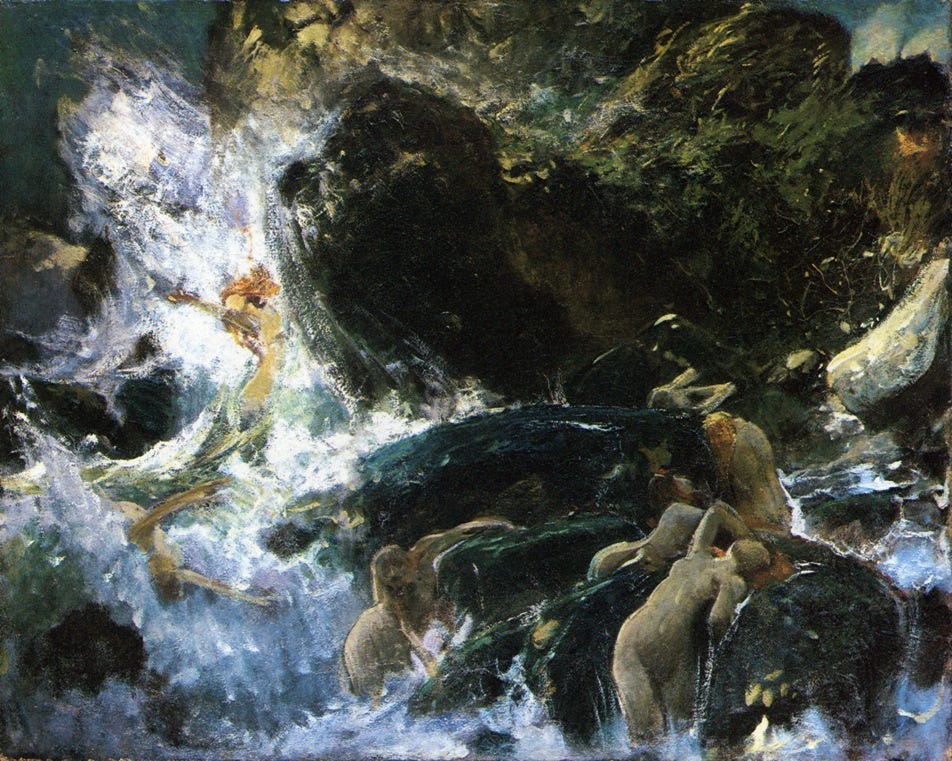
Recently, I finished a series of five essays (many of which began as drafts on this Substack) about the twins Siegmund and Sieglinde from Richard Wagner’s music drama Die Walküre. This body of work, in part owing to my severely diminished health last year, took a little over a year and a half to complete. When I wasn’t working on my book or other freelance assignments, these two people seemed to infiltrate every waking moment (and even some of my non-waking moments) of my life. Before I got sick, months passed where there wasn’t a free weekend or evening that could be spared for anything other than thinking about them. Thus, at the beginning of my infatuation, like all people in love, me and Big Rich spent a lot of time together. I poured over the text of the Ring cycle, listened to it four times front to back in the same number of weeks, read dozens of guides and other texts about it, penned fiction, poems, diagrams, and other ways of working through the material, some of which eventually made it into the essays albeit in fragmented forms.
After I got sick, both with my brain injury and with post-viral illness, the nature of this fixation changed along with everything else in my life, which had all of a sudden come to a stop. As the days passed by, each the same and as lifeless as the next, I clung to these two people, Siegmund and Sieglinde, with a mind so addled it hallucinated words and could barely form a coherent sentence. Because they were, in addition to being characters in a text, also pieces of music, this was a blessing for me because music can still communicate so much even if one is unable to make any sense of it. If the twins were anything else, if they were figures in a book or a film, I genuinely don’t think I would have loved them so much. (Although, to speak in their defense, these two people born into hell world, who live righteous lives despite extreme and gendered violence, who find one another and discover through love and solidarity the path forward into a better, freer way of being, feel particularly lovable these days!)
That being said, what differentiates the Ring from some of my more internecine obsessions, is that it is infamously one of the art world’s great rabbit holes. Thousands of people around the world are seduced into being Wagnerites at some point in their artistic development, even if, fortunately for them, it remains a largely juvenile phase. Those who get too into the Ring can spend the rest of their lives on the sheer totality of the thing (like me), or, alternatively, on just a few bars of music. It is, in many ways, a perfect thing to become obsessed with because the thing itself, by way of how it is — vast and infinitesimal at the same time — encourages it.
Thus, spending one’s life with the Ring is always very intellectually stimulating, in part because attempting to explain it can lead you in a million directions. It moves backwards and forwards, is both text and event. While my way into the cycle was pretty oblique, I did not in any way arrive at the Ring at random. It was the last in a long progression of obsessions that elided seamlessly into one another, each continuing on as its own theme in a seemingly endless string of counterpoint. These “hyperfixations”1 include the medieval families of 13th century Styria, the town of Ormož and its surroundings (about which I wrote an unpublished novella in 2023), the artist France Mihelič (about whom I wrote for Protean Magazine) or, my pathway into Wagner, Parzival and the Nibelungenlied. One thing, however, remains clear: the Ring was no different for me than any of those other things. Once I got into them I could not stop until their hold on me passed. Each time I fall in love with a subject, I become like a dog who finds a miraculous piece of garbage on the street: try and snatch it from me and I’ll bite off your hand. I don’t care if I’m a bad dog, that my taxes are late, that it’s 1 in the morning and I’m knee deep in Robert Donington’s Jungian analysis of Siegfried, that’s my trash!!!!!!!!!!!!
Being yoked around the world by one’s passions at the expense of what makes one broadly beloved to the public (being an architecture critic) may seem like an unsustainable way of living and working. But in my defense, when it works, it works splendidly, and even when it doesn’t work, I have no choice but to deal with it. I have been this way since childhood and there is no other way for me to be. When I was three I ran around the house naked to Vivaldi’s Four Seasons and begged my parents to let me play the violin, which I did for 20 years. When I was five I got in trouble at kindergarten for relaying with malignant glee just how many people died building the Great Wall of China. When I was 11 I could have told you anything you wanted to know about the weather. I became a child government pawn of the National Weather Service and carried my storm spotter card for many years.
At 15 I became obsessed with architecture and, ten years later, became the youngest ever serialized architectural critic in American history.2 (In)famously, of course, after lockdown, I uprooted my entire previous existence and everything in it in order to cover the Tour de France for three years.3 In order to get an edge on asking guys in lycra how sore their legs were I ended up learning Slovenian and getting way too into the Middle Ages (living in Castle World Europe will do that to you), to Slovene art, from Mihelič to the poems of Srečko Kosovel. Suffice it to say, despite being such a deleterious and unrestrained force, monomania remains the unceasing and immutable perpetuum mobile of what I ultimately consider to be a rich and productive life. (Whether that life is financially lucrative is another matter.)
*
The Ring, much like many of my larger-scale fixations, was almost magically generative not only in that it has produced an ongoing body of work but because it made me a far more well-rounded person than I was before. The places it lured me would’ve taken years to arrive at any other way, which is to say, by dipping in at random when one has the time. Most obviously, while classical music has been a lifelong obsession (perhaps, even, the only consistent one), owing to my unfortunate last name, I spent decades avoiding Wagner whenever possible, relegated him to the dustbin of my opera and modernity seminar in music school. Even in grad school at Peabody, Wagner to me remained a side character (one can even say a crank) in the grand pageant that is acoustical history via the Bayreuth Festspielhaus. But once I got “Ringpilled” (as I used to put it in unfortunate Millennial parlance) I was forced to dig up my music theory textbooks for the first time in a decade. I even returned to techniques of post-tonal theory in order to categorize certain leitmotifs in the form of sets. This was difficult work that never made it into my writing about the twins, though perhaps it may find an outlet in some supplementary work about the cycle.
Each essay I began led me on a journey of its own. For example, when I was working on the essay about Siegmund and whether his free will was real vs conditional, I disappeared down the rabbit hole of German Idealism,4 read Fichte, Hölderlin (already a lifelong love of my life), Hegel (though not the Phenomenology on which I’m taking a class at the Brooklyn Institute for Social Research next month), and Schelling. I peeked, as one is forced to do with Wagner, into Schopenhauer and 19th century readings of Buddhism. I paid a visit, for the first time since high school, to one of my oldest intellectual friends, Jean Paul Sartre. I began thinking about my own freedom, including as a political subject trapped in a hell world of my own, which was a difficult internal conversation to have. It may seem silly, but, in analyzing this brief albeit poetic life, there were many times in the past year where I was forced to ask myself, could I ever be like Siegmund? What risks were I willing to take to protect those more vulnerable than myself? Did I really have the requisite courage to try to bring forth the world I believed in even in miniature, even in the small worlds one forms with other people?
I will probably write more extensively (and for a different venue) about this later, but I ran into the same dilemma when working with the character Sieglinde, the woman who drugs the husband who rapes her, who, contrary to the cycle’s professed heroic narrative, saves her brother and herself, who is forced, in a harrowing monologue, to reckon with sum total of all female suffering before being left to die for the simple crime of not wanting to suffer anymore. This has been one of the most emotional and theoretical challenges I’ve ever taken on as both a writer and as a woman myself. To say that I carried this woman wherever I went (including and especially to psychoanalysis) is an understatement. I used her as a tool to work through some extremely difficult feelings that seemingly had no other way of coming to the fore except through music. I forced myself through her to read (and reread) a lot of the hard but good stuff out there about feminist thinking — Andrea Dworkin on sex and rape, Juliet Mitchell’s work on psychoanalysis and women, Simone de Beauvoir’s writing on women’s subjectivity and philosophical freedom, to name just a few.
While much of my interest in the twins had a sentimental or at least affective quality to it, during my work with the Ring, there were also many times I caught more than a few of what I call my “stray bullets” — things I’d probably never read or think about otherwise. Despite not being particularly interested in Norse mythology (I’m already blonde enough), I read the Prose Edda and the Volsunga Saga front to back, as well as the William Morris (yes, that William Morris, one of the world’s great polymaths) adaptation of the latter. I read Tolkien’s essay on dwarfs. I read the Nibelungenlied again, but this time in an academic rather than prose translation. (I also saw the Fritz Lang movies, which are almost diabolically beautiful to look at.)
The big stray bullet I caught, in this case, however, was the topic of incest, about which I read a number of books and articles, most of them historical and psychoanalytical texts.5 (Part of the reason I went so deep was because the topic is almost entirely whitewashed over in most guides to the cycle.) I’ve never been a prude about the fact that the Wälsung twins fall in love with one another; in fact I’ve always found it somewhat sweet, if very sad. The mystical idea of being born with and for someone materializes across many different facets of culture despite being fundamentally rooted in incestuous longing, which, by its very nature, hates the process of separation and differentiation responsible, by necessity, for making us our lonely, lonely selves. This I turned into a separate essay about the mirror-self.
the mirror-self

When one is born, one is fundamentally born separate. This is very unfortunate, however it is also, inevitably, a fact of life. We come into the world as infants who, around the time our consciousness begins to solidify into something rea…
I suppose, to wrap this all up: as I prepare, after six months of post-covid illness, to re-enter full time work and public life alike, I still find it difficult to say goodbye to this material, material which kept me afloat during a seemingly endless period of sickness, madness, and more sickness. Soon, the twins, like a handful of other objects and subjects (such as St. Barbara, the patron saint of architecture, Daphne,6 Ptuj Castle in Eastern Slovenia and the belligerent ministerials who once lived there,7 the eye, and the red lantern8) will become part of my personal mythology, a pantheon of symbols, many of which are even physically inscribed on my own body in the form of tattoos. In this, too, I will carry them with me forever. They will inevitably dissolve into something else. The cycle will continue and continue and continue until there is no more cycle, until there is nothing at all.
Thank you all for spending time with it.9
You can read the essays via Wehwalt.net, my website devoted to the Ring cycle.
I do not want to medicalize my obsessions, because they are living things that make up a huge part of my human experience. Blaming them on something like ADHD (despite my diagnosis) removes entirely the element of human intellect and the desire for understanding that is present in all people, not just those who have certain conditions. I do not think my tendency towards monomania is a form of sickness. I think it is an integral part of how I was socialized to learn (in that it is representative of a life largely lived inwardly) and how I view the world and myself. I make what I want of it. Sometimes other things in my life suffer because of it, but the energy and drive it brings to that life is something I would never medicate or will away.
My first print column (albeit briefly, during Chris Lehmann’s tenure as EIC) was in The New Republic. I had just turned 25 years old at the time. It was insane and the pandemic basically made me crash out lol. I’m still very proud of this even if it comes off as arrogant because I’m 32 now and there will be no such further accolades for the rest of my life. Ah, youth!
This was crowdfunded by my now-retired Substack Derailleur.
you’d think I’d have done this earlier when I first started calling myself a socialist, but what can you do
Especially important to me was the work of historian Brian Connolly, who recently published a fascinating essay about contemporary depictions of incest in Parapraxis. Julie Mitchell’s book Siblings was also instrumental.
Daphne was a common subject in the work of France Mihelič for whom she manifested as a symbol of male sexual guilt.
The Red Lantern (Lanterne Rouge) is the designation given to the last man to finish the Tour de France. It is a coveted distinction in its own right.
This also marks the end of my writing about the Ring on this newsletter. While I will post about further work on the topic via notes, the remainder of it will be published at my website about the Ring cycle, wehwalt.net. I will be returning to other content soon.
Hey, you may or may not resonate with this, but thanking your readers for "putting up with" your deep dive into the Twins really struck me, because I see myself in that language. I'm autistic, with special interests (not as a disease to cure, see also disability justice), and it's interesting to see the language I also sometimes use (to talk about my explorations into things that bring my life incredible meaning, emotion, and intellectual stimulation) reflected back at me. From my perspective on the outside, I empathize, AND there's also something alienating about it. Because it seems to imply, when I read it, that what you're putting out into the world is barely tolerable, instead of something that other people are actively excited about and value. Not everybody agrees, obviously, but such is life. (Something something Siegmund "Was rechtes je ich rieth, andern dünkte es arg" something something.) But I would imagine the people who do value it are the ones who will be reading that last sentence. I am!
As a total aside, I'm someone who engages with myth and mythic people as part of my actual religion/spirituality, and this essay added to the ever-growing itch in my brain to write or talk about the ecstatic/magical nature of music (which from my perspective is perhaps amplified when it's overtly entangled with spiritual figures). But also the urge to just leave that alone because some things are better felt than talked about. So idk.
Thanks for writing!
kate wagner...you are a super cool person. I got into the Ring thanks to an ex-wife who divorced me for a variety of reasons, but the alchoholism certainly didn't help. I curated a complete set of records and have lugged them with me for over forty years. Some years, at the end of winter, I like to start at the begining and try to make it through. This winter, I succeeded thanks to a boxed set of CDs from Bayreuth that came my way when I inherited someone else's huge classical music collection. I have it stacked upstairs in random grocery store boxes. I started writing and listening to the Ring and then I read your detailed study of Wagner's music and what a treat it was. Your work is very much appreciated.